Thursday, January 6, 2011

2010 Ford GT90 Super Sport Car Concept going to auction

2010 Ford GT90 Super Sport Car Concept

If Ford first introduced the GT90 Concept at the 2010 Detroit Auto Show next month, it would still be one of the most eyecatching cars on the show floor. What's amazing is that Ford unveiled the GT40 successor nearly 15 years ago. What's more, even by today's standards it's still a supercar among supercars.
The quad-turbocharged 6.0-litre V12 puts out an estimated 720 horsepower, the body is constructed completely of carbon fiber and top speed is somewhere in the 400 kph range. The only hints that it's not a modern supercar are the all-blue interior and wheels that look dated now.
So what's all the fuss about the GT90 Concept now? RM Auctions in the States has just announced that it will be offering the concept car at its upcoming Arizona sale. That's right, this is your chance to own one of the coolest concept vehicles of all time. This is the first time that the GT90 Concept has ever been publicly for sale at auction, and RM claims that it is in "excellent running condition, having been properly stored and maintained over the year." No estimated on price is given, but we're guessing it will take a large suitcase of cash to take the car home.
2010 Ford GT90 Super Sport Car Concept

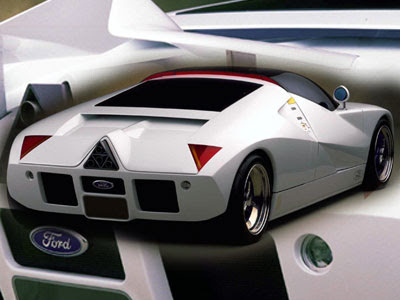
The one-off GT90 Concept Car, labeled immediately as "the world's mightiest supercar" by Ford Motor Company on December 6, 1994, was the spiritual successor to the Ford GT40, the product of a colossal feud in the early 1960s between the Blue Oval from Dearborn and the Prancing Horse of Northern Italy. The GT90 draws from the design cues of its heritage and pays homage to the famed Le Mans-winning Ford GT40s of the 1960s, which were created after the failed attempt by Ford to buy out Ferrari.
At a development cost in the neighborhood of $3 million, the GT90 was certainly worthy of pulling styling cues from the original Ford GTs, and although it was never meant for production, it was built according to a Ford press release as a "test bed for technology, engineering and design concepts, and driver-oriented features that eventually may be used in Ford production vehicles."
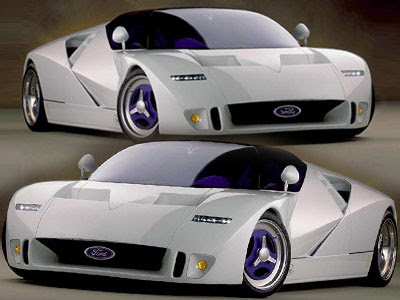
Officially unveiled to the public in January 1995 at the Detroit Auto Show, the GT90 is finished in bright white with a bright blue and carbon fiber interior. It features a mid engine quad-turbocharged V12 that produces an estimated 720 horsepower and 660 pound-feet of torque. As a result, it had a claimed top speed of 253 mph, which even by today's standards would make it one of the fastest production cars in the world – faster even than a McLaren F1, which was widely considered the world's preeminent supercar at the time.
2010 Ford GT90 Super Sport Car Concept

The engine, which was a 48-valve six-liter V12, had to be combined together with four Garrett Systems T2 turbochargers in order to reach its estimated 720 horsepower and was based on the Ford Modular engine. Created by using parts of two Lincoln V8 engines, engineers removed the last pair of cylinders from the rear of one engine and the first pair of cylinders from the front of the other engine. The cut-down engines were then welded together with the final result being a 90-degree V12, which utilized a 90.2 mm bore and a 77.3 mm stroke to achieve maximum power.
The GT90 features the FFD-Ricardo five-speed manual gearbox found on the XJ220 and, considering the torque load that it is designed to handle, is noted as having a relatively light shift quality. Also borrowed from the XJ220 comes the all around double wishbone suspension that was designed to enable the car to handle well at top speeds.
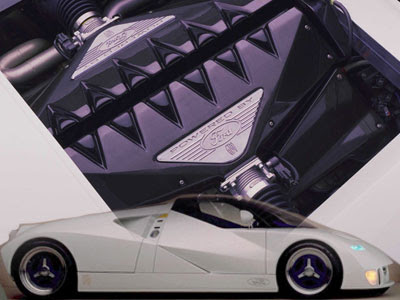
2010 Ford GT90 Super Sport Car Concept

Using Ford's new "Edge" design philosophy, the car incorporated advanced technology with a mixture of flat planes, angles, glass and triangular shapes that seemingly all collided together. The GT90 was the first car created using this new styling directive from Ford, which went on to be responsible for the creation of other Ford products like the Ka and Cougar. The effect is most impressive and a wonderfully executed stylistic throwback to its GT40 predecessor, which at once stays true to its heritage but acknowledges the advances in modern design. Taken directly from race car technology, the GT90 body panels are molded out of carbon fiber while the chassis is formed out of a honey-comb sectioned aluminum monocoque.
The GT90 is a test bed of advanced technology and design. It sports a tinted, laminated glass bubble over the cockpit and a spoiler that rises off the rear deck at high speeds. According to Ford, it has a "design that tightly enclosed its mechanicals with no wasted space; high tech lighting and blind-spot detection systems; and tiles like those on the space shuttle to shield the V12's exhaust outlets."
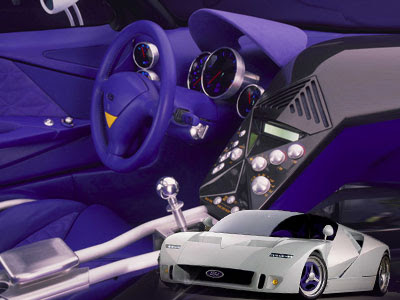
2010 Ford GT90 Super Sport Car Concept

After its unveiling in Detroit, the GT90 made its rounds on the Auto Show Circuit in 1995, traveling around the world to Frankfurt and as far away as Tokyo. With few other showings in between, the car recently was shipped over to Europe to be on display in the Ford of Europe 2008 exhibit at the Goodwood Festival of Speed. After returning home, the car was shipped to Alabama where it was on display as part of the Mustang 45th Anniversary Celebration.
This superb concept car remains in excellent running condition, having been properly stored and maintained over the years in between its show appearances. RM Auctions is proud to publicly offer the GT90 for the first time ever at auction. A remarkable one-off piece of automotive history and cutting-edge design, its offering may very well be a once in a lifetime opportunity for Ford devotees and concept car enthusiasts.
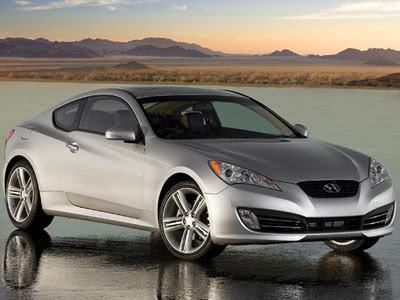
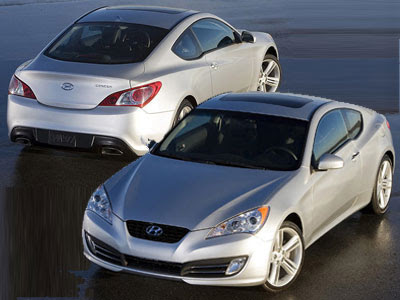
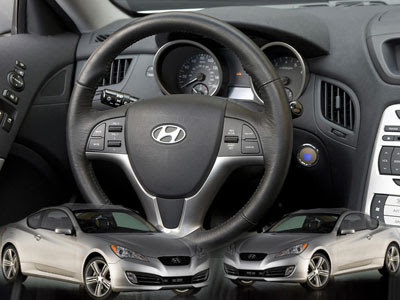
2010 Hyundai Genesis Sports Car Coupe with SHIFTRONIC to handle the additional torque

2010 Hyundai Genesis Sports Car Coupe with SHIFTRONIC to handle the additional torque

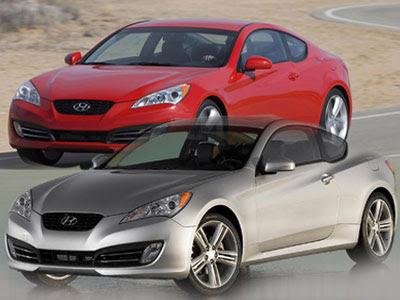
2010 Hyundai Genesis Sports Car Coupe

The people at South Korean automaker Hyundai are listening to their customers. The 2010 Hyundai Genesis Coupe, confirmed for production and a release early in 2009, follows the tradition of the 2009 Hyundai Genesis in offering a true high performance rear wheel drive, sporty architecture in an affordable package. The 2010 Genesis Coupe is a purpose-built rear-wheel drive sports coupe featuring two performance-focused engines - a212-horsepower 2.0-liter turbocharged four-cylinder engine and a range-topping all-aluminum 306-horsepower, DOHC 3.8-liter V6 engine.

2010 Hyundai Genesis Sports Car Coupe

Genesis Coupe employs a MacPherson strut dual-link front suspension and a five-link rear suspension setup. Both engines are mated to a standard six-speed manual transmission. The Genesis Coupe 2.0t (2.0-liter 4-cylinder turbo) offers an optional five-speed automatic with SHIFTRONIC® while the 3.8-liter V6 offers a ZF six-speed automatic transmission with SHIFTRONIC to handle the additional torque.
The Genesis Coupe follows the styling tradition set forth by the Hyundai Tiburon, but outdoes that aging Hyundai compact sports car in every way. The Genesis Coupe comes with an available naturally aspirated V6, sure to be a motor to find its way into more of Hyundai's lineup. The high output engine offers 310 horses on premium fuel. Following the introduction earlier this year of the rear-wheel drive Genesis sport sedan, Hyundai Genesis Coupe is Hyundai's most dynamic performance car ever and the second consecutive all-new model introduction from Hyundai appealing directly to the car enthusiast.

2010 Hyundai Genesis Sports Car Coupe

Hyundai Genesis Coupe uses the same flexible rear-wheel drive architecture originally developed for the Genesis sport sedan.
The 2010 Hyundai Genesis Coupe offers Xenon high-intensity discharge (HID) headlights. The advantages of HID headlamps include greater lighting power, daylight-type lighting and reduced power consumption. In addition, the cut lines of the new HID headlights are extremely precise, providing maximum nighttime visibility without distracting other drivers.
All Hyundai Genesis Coupe models feature standard four-channel ABS with Electronic Brake-force Distribution (EBD) to optimize brake performance under various dynamic loading conditions. The system also includes Brake Assist, which provides maximum ABS-level braking force when a panic stop is detected.

2010 Hyundai Genesis Sports Car Coupe

It is nice to see that Hyundai, an automaker currently enjoying growth and a solid reputation for producing mainstream-market cars that last, is making steps toward the sports car market. The styling of the Genesis Coupe is hit or miss, some will love it and others will wonder what Hyundai was thinking. But, with the sports car pedigree to back it up, the Genesis Coupe should be another worldwide hit for Hyundai.

2010 Hyundai Genesis Sports Car Coupe

The Hyundai Genesis Coupe is offered in three trim levels: the stylish and affordable GS, the premium-sport GT featuring the 3.8-liter V6, and the high-performance SE, available with either the 2.0-liter turbocharged four-cylinder engine or the 3.8-liter V6 engine.

Sunday, September 26, 2010

2011 Perana Sports Car Z-One

South Africa is quickly becoming a hotbed for sports car development, with two new performance machines being announced in the country in just as many weeks. Built through collaboration between Zagato, the Milanese coachbuilders, and Perana Performance Group, the Z-One features a tubular and box section chassis with room for two passengers. Tucked among the exotica at Concorso Italiano  was the new Zagato-styled, Hi-Tech-built and Superfomance-sold, Perana Z-One sports/GT.
2011 Perana Sports Car Z-One
The Perana sports car Z-One is designed in Italy, powered by American muscle and manufactured in South Africa. The "Z" stands for Zagato, Chief Designer Norihiko Harada using the Italian design house's DNA to form a dynamic supercar.
The sports car Perana Z-One will go on sale in the U.S. through Superformance after its Concorso Italiano debut in August. American buyers will get an allocation of just 99 units, so you probably won’t be seeing one parked outside of your local trattoria any time soon.
2011 Perana Sports Car Z-One is beautiful. And the build quality is exquisite. The panel gaps put all the high-priced Italian vehicles surrounding it to shame. The styling is definitely that of a European GT.
2011 Perana Sports Car Z-One 
The 6.2L V8 engine generates 440hp (328kW) and 430lb-ft of torque (583Nm) of torque, and redlines at 6,600rpm. That's enough to scoot the 2,630lb (1,195kg) car to 62mph (100km/h) in an estimated sub-4 second time. Big brakes - 325mm up front, 305mm in the rear - slow things down again, while unequal length A-arms, Bilstein shocks and Eibach springs at all four corners handle the curves.
The drivetrain comes from Chevy, the Corvette's 6.2-liter V-8 delivering 440 bhp to the rear wheels. The Z-One also uses the Vette's 6-speed manual gearbox, but the tubular space frame has been engineered in South Africa. Perana claims 0–60 mph in just 4 seconds.
2011 Perana Sports Car Z-One is the limited production, because the gorgeous body of each Perana Z-One will be handbuilt in Italy by coachbuilder Zagato and then shipped in pieces to South Africa where there are attached to the vehicle’s chassis. The Z-One's chassis has been completely conceived and designed by Perana engineers in South Africa, despite the engine sourced from General Motors.

Thursday, September 23, 2010

Pre-war Car Petr Novague ECO Car Concept Inspired by F1 Technology

The concept vehicle is christened as ECO and features tube car frame, half-hood body and carbon components that add minimum possible weight to this energy efficient and eco friendly vehicle. Created by Petr Novague as a mark of respect for Laurin and Klement, a pre-war Czech company, Further, chromium-molybdenum steel made lattice truss frame in the front part of the car is attached to the carbon frame with inside honeycomb.
The concept vehicle is combines the old traditions of pre-war cars with the modern and innovative technology and system logic.
Pre-war Car Petr Novague ECO Car Concept Inspired by F1 Technology
ECO is powered by the electric motors that are located in the narrow wheels. Electric motors are powered by the batteries located under the tilting front lid, which also works as door. With zero tail pipe emission, ECO offers clear and green ride added with comfort and range of 500 km per charge.
Hailed as “ECO,” the concept car features tube car frame, half-hood body and carbon components, which makes it a lightweight and energy efficient vehicle.
Pre-war Car Petr Novague ECO Car Concept Inspired by F1 Technology
Moreover, the ECO car can change it ground clearance, thanks to the double-wishbone axel disposes of the push rod suspension, uniball endings and impact dampers, according to the road or terrain.
Attaching the lattice truss frame, made in chromium-molybdenum steel, to the carbon frame with inside honeycomb upfront that is inspired by F1 technology, the retro-futuristic car also touts electronic drive-line (4 x 4) with stabilization system, which reduces the weight of mechanical connections by a huge margin.

2010 Volkswagen Sports Cars - VW Solar Powered Supercar Concept


It is a luxury supercar, it will only be built in a limited number of 200 units. It was designed to be able to cruise around in the year 2020. Volkswagen supercar presented at the 2010 Swansea Metropolitan University Degree Show in automotive design by Peter Wilkins not only promises to run by solar power with greater efficiency but also offers a competitive design styling.
2010 Volkswagen Sports Cars - VW Solar Powered Supercar Concept
Peter Wilkins has designed one helluva eco-friendly car for the 2010 Swansea Metropolitan University Degree Show. His supercar would run off of an electric motor powered by photovoltaic cells, or a hydrogen fuel cell stack. Peter Wilkins’ design is one of the sexiest eco-cars I have ever seen. Making earth-friendly cars that look good is a great idea.
The unique design of Wilkins permits each of the four wheels of the vehicle to be driven by an independent electric motor powered by solar energy stored in photovoltaic (PV) cells. The upper external surface of the vehicle stores the PV cells that further supply power to the mid-mounted hydrogen fuel-cell stack, which is directly linked to the electric motors. Placement of the PV cells and hydrogen fuel-cell stack form an integral part of the elegant design of the eco car that looks like part of a supercar.
The “VW Solar Powered Supercar” by designer Peter Wilkins is a concept car that demonstrates the aesthetic aspect of eco-friendly vehicles to attract more people toward sustainable commuting.
Simply known as the “VW Solar Powered Supercar”, this vehicle shows how just clean and green travel can get, and fast too. To power up, the car turns its face away from the smelly gas pump and integrates photovoltaic cells in its body instead. It uses these to juice up with solar power.

 2010 Volkswagen Sports Cars - VW Solar Powered Supercar Concept
The energy generated is used to power up a mid-mounted hydrogen fuel cell stack, resulting in a drive without the smoke and the pitch-black carbon footprint supercars usually leave behind these days.

Wednesday, September 22, 2010

2010 Caterham Sport Cars Seven Roadsport 125 Monaco


Manufacturer of specialist lightweight sports cars, Caterham Cars, announced the latest Special Edition. The Lotus Seven, and the Caterham Seven have been around for 53 years, it is still one of the basic and quintessential sports cars made. The Seven was never about power, it was about lightweight, minimalistic driving, and it remains true to it’s roots today. Caterham Cars is evoking the elegance, class and rich motorsport heritage of Monte Carlo with the latest Special Edition of its similarly timeless sportscar, the 2010 Caterham Sport Cars Seven Roadsport 125 Monaco.
The latest incarnation of Caterham’s iconic Seven, the Roadsport 125 Monaco, remains true to the original design by Colin Chapman in 1957. The Monaco features the British automaker’s brushed aluminum bodywork, with black nose and wheel guards. The familiar red and white of the Monegasque flag, the official flag of Monaco, form a motif that runs the length of the car, which takes us back to the golden era of motorsport.
2010 Caterham Sport Cars Seven Roadsport 125 Monaco
Caterham have kept the car fresh by producing several special editions over the years and this Monaco Edition is the latest. Powered by a 1.6 liter Ford four cylinder, it produces 125 horsepower and 120 ft/lb of torque, which should be entertaining since the car only weighs 1,100-1,200 pounds! According to Caterham the car is good for a six second 0-60 run and a top speed of 112mph.
Under the skin, the engineering is pure Caterham. The 1.6-litre Ford engine produces a top speed of 112mph and a power-to-weight ratio of 227bhp per tonne. The 5-speed gearbox propels the lightweight 500kg chassis from 0-60mph in under six seconds and full weather kit means the Roadsport is thoroughly enjoyable in any conditions.
The Roadsport 125 Monaco options include the wide SV chassis and a lowered floor for extra comfort in the cockpit. The company added that the all black trim is also available for the customers to choose from.
For just £20,995, the Roadsport 125 Monaco combines Caterham’s thrilling performance and driving experience with a unique touch of European flare and glamour. However, the first 20 cars to be ordered are available for just £19,995.

Monday, September 6, 2010

2010 Bugatti Sports Cars Veyron from Mansory by Linea Vincero d’Oro


MANSORY understands the importance of combining luxury and technology with the golden aspirations of this unique sports cars. Adding to the list of many modified Bugattis sports cars, Mansory LINEA Vincerò d’Oro has created this incredibly gaudy-looking Veyron. It’s got some design changes, it’s got some gold and it’s one of a kind. However, Mansory will perform this modifications for anyone who has the cash to pay for it.


With the LINEA Vincerò d’Oro, MANSORY has completed its strictly limited series sports cars for the refined Bugatti Veyron 16.4 sports cars. Using targeted changes, MANSORY first transformed the Bugatti Veyron sports cars into the LINEA Vincerò and then, using a special gold-coloured alloy, into the unique LINEA Vincerò d’Oro.


This one-off super car tune job by Mansory is perfect for the individual with nearly inexhaustible wealth. The Mansory Linea Vincero d’Oro version of the Bugatti Veyron adds a carbon fiber aerodynamics kit and gold details on the grille, the tires, the door handles and gas tank. The interior is equally accented in gold color, but the rest of this beast is all Bugatti sports cars.


Along with such gaudy monstrosities as the Pepto-pink Bentley and the Polo Sport-on-acid Porsche Panamera, Mansory has modified the Veyron sports cars with the Linea Vincero range of accessories, including a full aero kit and highly polished carbon-fiber body panels that include copper threads interwoven into the material for even more flash.


MANSORY manufactures almost all the components in the car’s body from ultra-light, high-strength carbon and the autoclave method of hardening under high pressure and high temperatures used during the manufacturing process makes a huge improvement to the quality of the materials. One unique feature of the design of the LINEA Vincero d’Oro is the carbon fabric with inbuilt copper thread used by MANSORY, the metallic sheen of which really brings out the exceptional nature of this special sports cars.


2010 Bugatti Sports Cars Veyron from Mansory by Linea Vincero d’Oro
The sideskirts have also been remodelled, as to offer a more stunning look. To give the engine optimal cooling, Mansory has created larger air outlets to the side and rear of the Veyron. The diffuser has also had some work done, as to help with the handling of the sports cars.
Mansory and LINEA Vincero previously introduced a Bugatti sports cars with visual and performance upgrades that cost an extra $985,776 – on top of the sports cars.

2010 Bugatti Sports Cars Veyron from Mansory by Linea Vincero d’Oro


MANSORY understands the importance of combining luxury and technology with the golden aspirations of this unique sports cars. Adding to the list of many modified Bugattis sports cars, Mansory LINEA Vincerò d’Oro has created this incredibly gaudy-looking Veyron. It’s got some design changes, it’s got some gold and it’s one of a kind. However, Mansory will perform this modifications for anyone who has the cash to pay for it.


With the LINEA Vincerò d’Oro, MANSORY has completed its strictly limited series sports cars for the refined Bugatti Veyron 16.4 sports cars. Using targeted changes, MANSORY first transformed the Bugatti Veyron sports cars into the LINEA Vincerò and then, using a special gold-coloured alloy, into the unique LINEA Vincerò d’Oro.


This one-off super car tune job by Mansory is perfect for the individual with nearly inexhaustible wealth. The Mansory Linea Vincero d’Oro version of the Bugatti Veyron adds a carbon fiber aerodynamics kit and gold details on the grille, the tires, the door handles and gas tank. The interior is equally accented in gold color, but the rest of this beast is all Bugatti sports cars.


Along with such gaudy monstrosities as the Pepto-pink Bentley and the Polo Sport-on-acid Porsche Panamera, Mansory has modified the Veyron sports cars with the Linea Vincero range of accessories, including a full aero kit and highly polished carbon-fiber body panels that include copper threads interwoven into the material for even more flash.


MANSORY manufactures almost all the components in the car’s body from ultra-light, high-strength carbon and the autoclave method of hardening under high pressure and high temperatures used during the manufacturing process makes a huge improvement to the quality of the materials. One unique feature of the design of the LINEA Vincero d’Oro is the carbon fabric with inbuilt copper thread used by MANSORY, the metallic sheen of which really brings out the exceptional nature of this special sports cars.


2010 Bugatti Sports Cars Veyron from Mansory by Linea Vincero d’Oro
The sideskirts have also been remodelled, as to offer a more stunning look. To give the engine optimal cooling, Mansory has created larger air outlets to the side and rear of the Veyron. The diffuser has also had some work done, as to help with the handling of the sports cars.
Mansory and LINEA Vincero previously introduced a Bugatti sports cars with visual and performance upgrades that cost an extra $985,776 – on top of the sports cars.

2010 Bugatti Sports Cars Veyron from Mansory by Linea Vincero d’Oro


MANSORY understands the importance of combining luxury and technology with the golden aspirations of this unique sports cars. Adding to the list of many modified Bugattis sports cars, Mansory LINEA Vincerò d’Oro has created this incredibly gaudy-looking Veyron. It’s got some design changes, it’s got some gold and it’s one of a kind. However, Mansory will perform this modifications for anyone who has the cash to pay for it.


With the LINEA Vincerò d’Oro, MANSORY has completed its strictly limited series sports cars for the refined Bugatti Veyron 16.4 sports cars. Using targeted changes, MANSORY first transformed the Bugatti Veyron sports cars into the LINEA Vincerò and then, using a special gold-coloured alloy, into the unique LINEA Vincerò d’Oro.


This one-off super car tune job by Mansory is perfect for the individual with nearly inexhaustible wealth. The Mansory Linea Vincero d’Oro version of the Bugatti Veyron adds a carbon fiber aerodynamics kit and gold details on the grille, the tires, the door handles and gas tank. The interior is equally accented in gold color, but the rest of this beast is all Bugatti sports cars.


Along with such gaudy monstrosities as the Pepto-pink Bentley and the Polo Sport-on-acid Porsche Panamera, Mansory has modified the Veyron sports cars with the Linea Vincero range of accessories, including a full aero kit and highly polished carbon-fiber body panels that include copper threads interwoven into the material for even more flash.


MANSORY manufactures almost all the components in the car’s body from ultra-light, high-strength carbon and the autoclave method of hardening under high pressure and high temperatures used during the manufacturing process makes a huge improvement to the quality of the materials. One unique feature of the design of the LINEA Vincero d’Oro is the carbon fabric with inbuilt copper thread used by MANSORY, the metallic sheen of which really brings out the exceptional nature of this special sports cars.


2010 Bugatti Sports Cars Veyron from Mansory by Linea Vincero d’Oro
The sideskirts have also been remodelled, as to offer a more stunning look. To give the engine optimal cooling, Mansory has created larger air outlets to the side and rear of the Veyron. The diffuser has also had some work done, as to help with the handling of the sports cars.
Mansory and LINEA Vincero previously introduced a Bugatti sports cars with visual and performance upgrades that cost an extra $985,776 – on top of the sports cars.